Duolingo is the world's most popular language app, with over 100 million monthly users learning through bite-sized, gamified lessons across more than 40 languages. Sticky takes a different path: it uses AI to turn your own notes into flashcards, then schedules them with spaced repetition so the words stick.
These are not direct rivals. Duolingo is a complete guided course, while Sticky is a flashcard and review tool. Duolingo did finally add a Flashcards exercise to its lessons in November 2025, five years after shutting down its Tinycards app. But the new exercise drills small stacks of Duolingo's own course words: you still cannot make flashcards from your own vocabulary or control how they are reviewed.
So the real question is not which app wins. It is whether Duolingo's guided lessons are enough on their own, or whether you need real flashcards to lock in the vocabulary you actually care about. This guide breaks down exactly how the two compare.
Quick Verdict
you want a free, gamified course that teaches a popular language from scratch with daily streaks, no setup, and a clear path to follow.
you want to turn your own vocabulary lists into flashcards and review them with true spaced repetition, in any language or subject Duolingo does not cover.
What Is Duolingo?
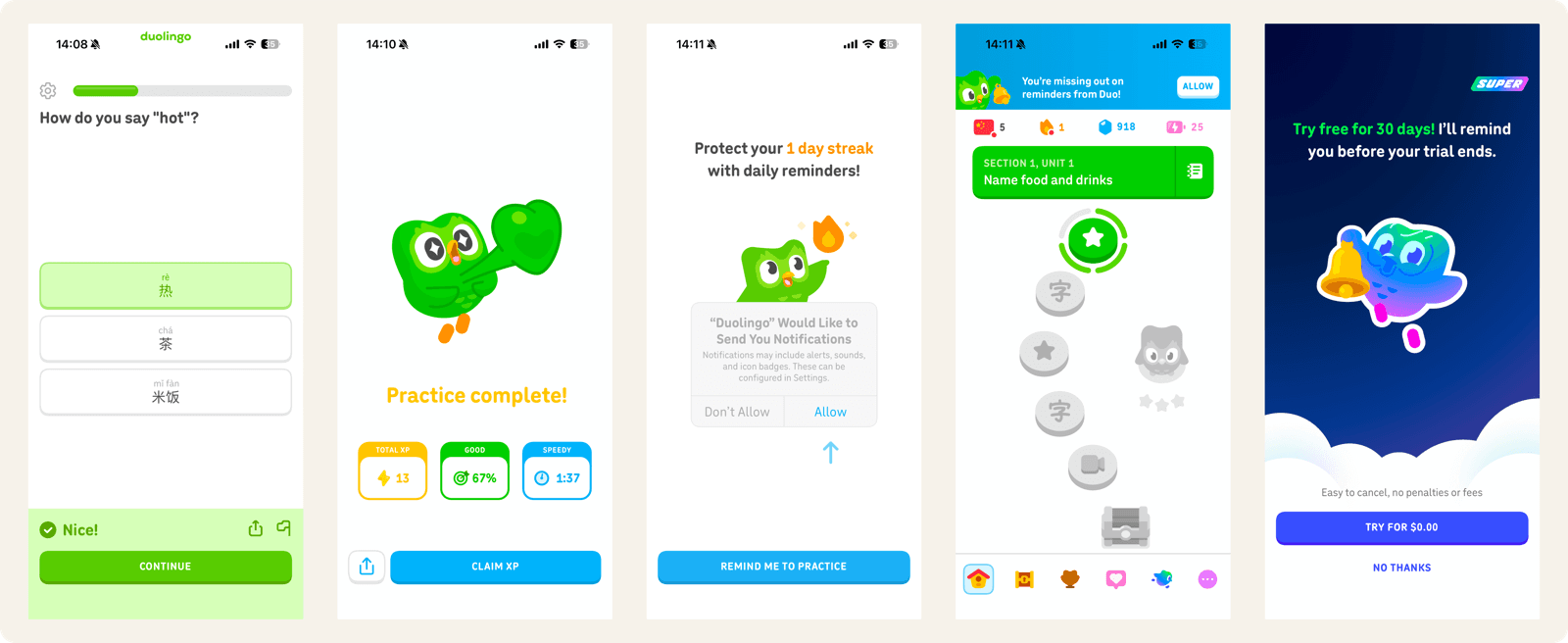
Duolingo is a language-learning app founded in 2011 by Luis von Ahn and Severin Hacker. It teaches through short, gamified lessons, and its design leans heavily on motivation: daily streaks, experience points, leagues, and a hearts system that limits how many mistakes you can make before you pause. That formula has made it one of the most downloaded education apps in the world.
The free tier covers full courses in more than 40 languages, supported by ads and the hearts limit. Super Duolingo removes both and adds the Practice Hub. Duolingo Max, the top tier, adds GPT-4 conversation features like Roleplay and Video Call for a handful of languages. What Duolingo does not include is a way to study your own material: the curriculum is fixed, and you learn the words Duolingo chooses, in the order it chooses them.
What Is Sticky?
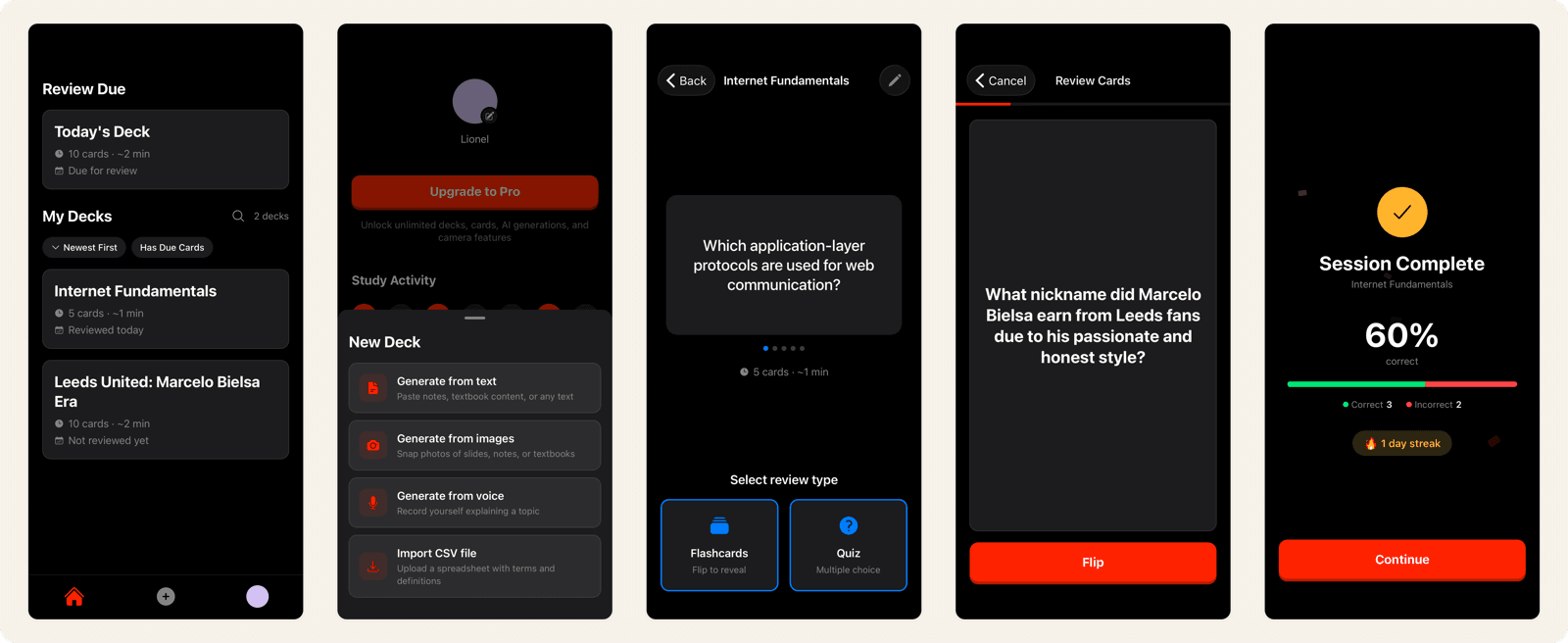
Sticky is an iOS app built around two ideas: AI-powered card creation and spaced repetition scheduling.
Instead of following a fixed course, you start with your own material. You take a photo of your notes, textbook, or a vocabulary list and Sticky's AI generates flashcards in seconds. You can also paste text or use voice. Once your cards exist, Sticky's SM-2 algorithm tracks each one individually and schedules reviews at expanding intervals, showing you a card just before you would forget it. There is no daily card limit and no paywall on the core study features. For languages, that means you can build a deck from the exact words your class or trip requires, then rely on spaced repetition for language learning to retain them.
Duolingo Features vs Sticky: Side-by-Side Comparison
Here is how the two tools compare across what matters for learning and retention.
| Feature | Duolingo | Sticky |
|---|---|---|
| Core approach | Gamified language course | Flashcards from your own notes |
| Custom card creation | No, in-lesson stacks only | AI from photos, text, and voice |
| Spaced repetition | Automatic, Duolingo's words only | SM-2 on every card, no daily limit |
| Subjects covered | 40+ languages, fixed courses | Any language or subject |
| Study your own material | No | Yes |
| AI features | Roleplay, Video Call (Max tier) | Photo to Card, Note to Card |
| Gamification | Streaks, leagues, hearts | None, focus is on review |
| Platforms | iOS, Android, web | iOS |
| Ads | Yes on the free tier | No ads or upgrade prompts |
| Pricing | Free / Super around $84 per year | Free with premium options |
Duolingo Flashcards vs Sticky: The New Exercise and Its Limits
This is the difference most people are searching for, so it is worth being precise about it.
Duolingo's history with flashcards has two chapters. Its standalone app, Tinycards, launched in 2016 and let you build and study custom decks, but Duolingo shut it down in September 2020 and replaced it with nothing for five years. Then, in November 2025, Duolingo announced a Flashcards exercise inside its lessons. You get a stack of five cards, each showing a word in your own language, and you say or type the translation in the language you are learning. Answer correctly and the card clears; miss it and the card flips to reveal the answer with audio, then returns to the back of the stack.
It is a genuine active recall exercise, and a real improvement. But it is also narrow. The cards live inside lessons, drawn from Duolingo's own course vocabulary in small fixed stacks. You cannot create your own decks, add words from your class or textbook or trip, or decide when a card comes back. In other words, Duolingo now has flashcards, but not your flashcards.
Sticky is built for exactly that job. You photograph a vocabulary list, paste a set of terms, or speak them, and the AI produces a deck. Because the cards come from your own material, they match the words your teacher emphasised or the phrases you need for a specific trip, not a generic syllabus. Research on effective flashcard design shows that cards testing one clear idea at a time produce the strongest recall, and Sticky's generation follows that principle.
If your goal is to drill a particular set of words and remember them for months, the gap is real: Duolingo's new exercise cannot do it, and Sticky is designed around it.
Duolingo Spaced Repetition vs Sticky: Automatic vs Your Own Cards
Both tools use spaced repetition, but in very different ways.
Duolingo's version runs automatically inside its courses. The company published its approach in a 2016 research paper (Settles and Meeder), describing a half-life regression model that predicts when you are likely to forget a word and resurfaces it during Practice. It works well, but it only applies to Duolingo's own vocabulary, and you have no control over the schedule or what enters it.
Sticky puts the same principle in your hands. Every card you create is scheduled with the SM-2 algorithm. When you rate a card Easy, Medium, or Hard, the algorithm sets the next review date, and each card is tracked on its own. This is active recall on a deliberate schedule, applied to material you chose. There is no daily cap, so a heavy review day is decided by the algorithm rather than an artificial limit.
How Intervals Expand Over Time
Each successful review pushes the next one further out. Switch between schedules to see how difficulty and ease factor affect the progression.
The default SM-2 progression. Balances review frequency with long-term retention.
Intervals shown assume consistent “Medium” or “Easy” ratings. A “Hard” rating resets the card to a short interval.
The trade-off is straightforward. Duolingo's scheduling is effortless but locked to its content. Sticky's scheduling takes a little setup, because you build the deck, but it works on anything you want to remember.
Duolingo Content vs Sticky: Fixed Courses vs Your Material
Duolingo's content is its strength and its limit. The courses are well structured, professionally produced, and free, which makes starting a new language genuinely easy. If you want to learn Spanish or French from zero with a clear path, that polish is hard to beat.
The limit appears once your needs get specific. A fixed course cannot teach the vocabulary on your university syllabus, the medical terms for your nursing exam, or the regional slang for a particular trip. Less common languages often have thin courses or none at all.
Sticky has no fixed curriculum, so it adapts to whatever you are studying. You can build a Spanish vocabulary deck from your class word list, a French vocabulary deck for an upcoming exam, or a deck in a language Duolingo does not offer. The same workflow handles non-language subjects too, which matters if you are revising for several courses at once.
Duolingo Pricing vs Sticky: What You Actually Pay
Duolingo's core courses are free, funded by ads and the hearts system that pauses you after a few mistakes. Super Duolingo removes both and unlocks the Practice Hub, costing roughly $84 to $96 per year depending on region, or about $12.99 per month. Duolingo Max adds the AI conversation features and runs near $168 per year. A Family plan covers up to six accounts for $119.99 per year.
Sticky is free to download with its core features included. AI card creation and full SM-2 spaced repetition are available without a subscription, and there are no ads or upgrade prompts during study sessions.
The honest comparison is about what each charges for. Duolingo's paid tiers mostly buy convenience and AI conversation practice on top of a free course. Sticky includes the features that define it, card creation and scheduling, at no cost, because those are the point of the app rather than an upsell.
Who Should Use Duolingo
Duolingo is a strong choice if:
- You are starting a popular language from scratch. The structured, gamified courses make the first steps approachable and require no setup.
- You are motivated by streaks and games. Daily goals, leagues, and points keep many learners coming back, which is half the battle with a new language.
- You want guided conversation practice. Duolingo Max's AI Roleplay and Video Call features offer speaking practice within the app.
- You prefer to follow a path. If you would rather be told what to learn next than build your own study plan, Duolingo's fixed curriculum is an advantage.
Who Should Use Sticky
Sticky is a strong choice if:
- You want custom flashcards Duolingo still does not offer. Duolingo's in-lesson Flashcards drill its own course words in fixed stacks. Sticky creates decks from your own material in seconds.
- You study specific vocabulary. For a class word list, an exam glossary, or trip phrases, Sticky lets you drill exactly the words you need.
- You need long-term retention. The SM-2 algorithm is built for remembering material for months, not just passing today's lesson.
- You study more than one subject. Beyond languages, Sticky handles any topic, with curated decks like Spanish vocabulary ready if you want to start immediately.
- You want a distraction-free tool. No ads, no hearts, no upgrade prompts, just your cards and a schedule.
Is Sticky the Best Duolingo Alternative for Flashcards?
Duolingo and Sticky solve different problems, so the best answer is often to use both. Duolingo is excellent at getting you started in a popular language and keeping you coming back day after day. Its new in-lesson Flashcards make recall practice better, but they still cannot turn your own vocabulary into flashcards or let you control how reviews are scheduled.
That is the exact gap Sticky fills. If you love Duolingo but keep forgetting words, adding a flashcard app with true spaced repetition is the missing piece. If you need to study material Duolingo's fixed courses do not cover, Sticky works where Duolingo stops.
For learners who want real flashcards, scheduling they control, and the freedom to study any language or subject, Sticky is the more direct fit. If it is the gamified style you would miss most, see how Sticky compares to Gizmo, a flashcard app built around streaks and hearts. Or explore more study guides and learning science to build a routine that actually sticks.