Gizmo is a gamified AI study app that turns PDFs, YouTube videos, and notes into flashcard quizzes, and it has built a devoted following among UK students revising for GCSEs and A-levels. Sticky is an AI flashcard app with a narrower focus: create cards from your notes in seconds, then review them on a schedule set by the SM-2 spaced repetition algorithm. Gizmo is best for students who study more when learning feels like a game, while Sticky is best for students who want distraction-free reviews timed for long-term retention.
Quick Verdict
you want studying to feel like a game, with quiz battles, leaderboards, and streaks, and you like generating cards from YouTube videos, PDFs, and lecture recordings.
you want AI to turn your own notes into flashcards instantly and prefer a focused, ad-free review experience scheduled by the proven SM-2 algorithm.
The Short Version
Both apps use AI to build flashcards for you, so the real decision comes down to how you want to review them:
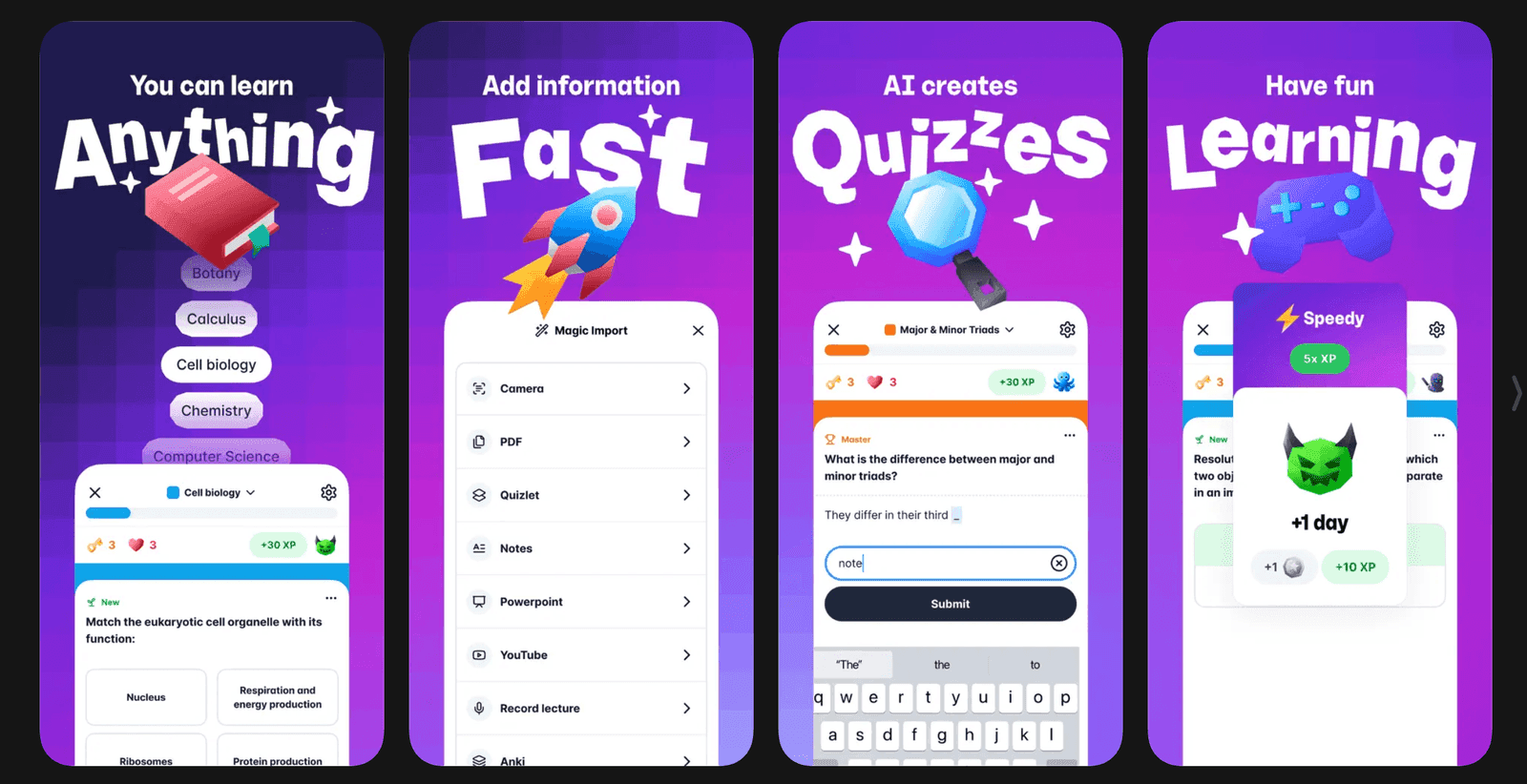
- Pick Gizmo if game mechanics keep you studying. Quizzes, hearts, XP, and the Gizmo Live group game make revision feel closer to Duolingo than to a deck of cards. It also accepts the widest range of inputs: PDFs, YouTube, PowerPoints, audio recordings, and imports from Quizlet and Anki.
- Pick Sticky if you want the highest-value study method with the least friction. Photograph your notes, get cards, review them when the SM-2 algorithm says so. No hearts to run out of, no wait timers, no leaderboard pulling your attention.
- The pricing gap matters. Gizmo Unlimited is priced weekly at $13.99, which adds up fast outside the yearly plan. Sticky's core features, including AI card creation and full spaced repetition, are free.
The rest of this guide covers the details behind each of those calls.
What Is Gizmo?
Gizmo is an AI-powered study app built by UK company Save All Ltd, which originally launched the product under the name Save All before rebranding to Gizmo. It is available on iOS, Android, and the web at app.gizmo.ai, and holds a 4.6-star rating from over 12,000 reviews on the UK App Store.
Gizmo's pitch is "get addicted to learning". You feed it study material in almost any format: PDFs, YouTube videos, typed notes, PowerPoint slides, audio recordings of lectures, even photos of handwritten notes. The AI converts it all into flashcard quizzes, which Gizmo resurfaces on a spaced repetition schedule. On top of that sits a thick layer of gamification: hearts that deplete when you answer wrong, XP, streaks, leaderboards, and Gizmo Live, a group quiz game you can play with classmates. An AI tutor explains wrong answers step by step, with a simplified mode for tricky concepts. There is also a library of over 1,000,000 public flashcards, plus importers for Quizlet and Anki decks.
What Is Sticky?
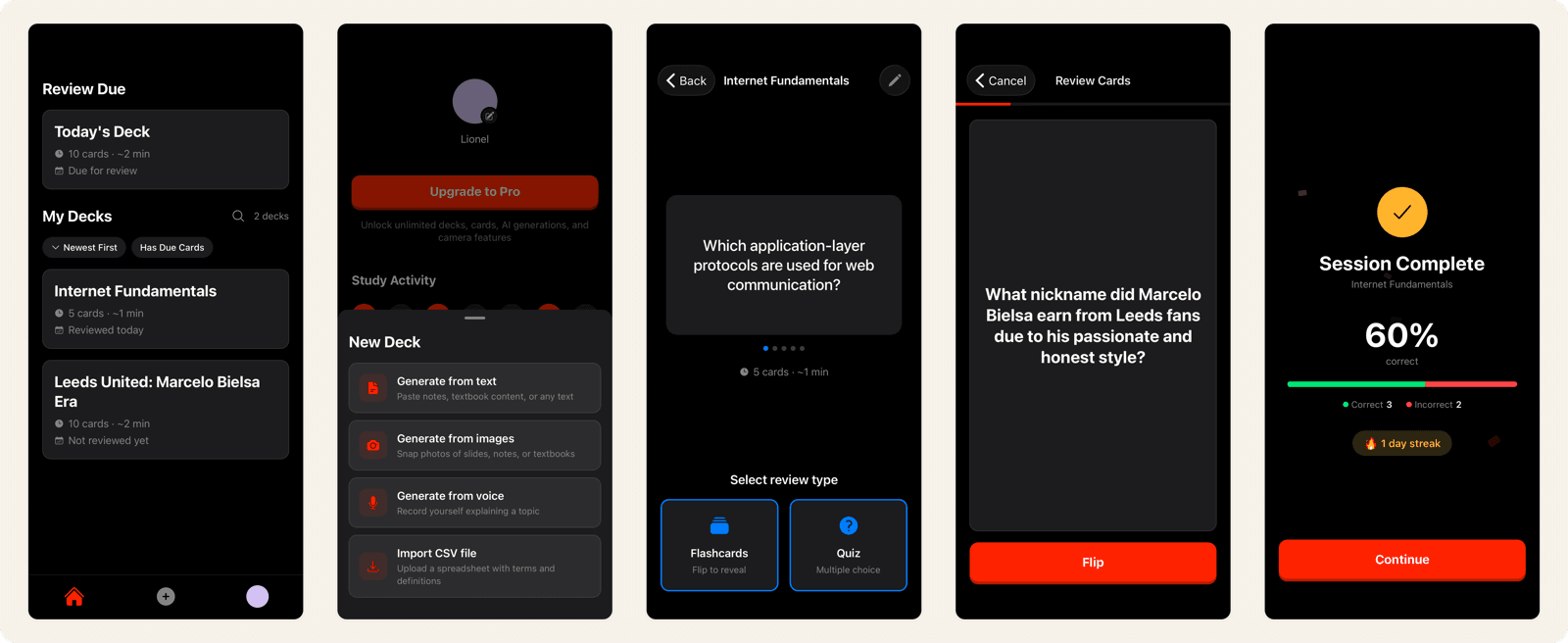
Sticky is an iOS flashcard app that strips studying down to two steps: create cards with AI, then review them on a schedule backed by the SM-2 algorithm.
Photograph your lecture notes, textbook page, or whiteboard and Sticky's AI turns it into question-answer flashcards in seconds. You can also paste text or use voice input. From there the spaced repetition engine takes over, tracking your performance card by card and surfacing each one right before you would forget it. Every review is an act of active recall, the study method with the strongest evidence base in cognitive science. There are no ads, no hearts, and no daily limits standing between you and your reviews.
Gizmo Features vs Sticky: Side-by-Side Comparison
Here is how Gizmo and Sticky compare across the features that matter most for studying.
| Feature | Gizmo | Sticky |
|---|---|---|
| Card creation | AI from PDFs, YouTube, notes, audio | AI from photos, text, and voice, plus CSV import |
| Spaced repetition | Quiz-based schedule, algorithm unpublished | SM-2 algorithm, built into every review |
| AI tutor | Step-by-step explanations for wrong answers | No conversational tutor |
| Study modes | Gamified quizzes, Gizmo Live group games | Spaced repetition review, Quiz mode |
| Gamification | Hearts, XP, streaks, leaderboards | Minimal, review streaks only |
| Pre-made content | 1,000,000+ public flashcards | Curated subject decks |
| Imports | Quizlet, Anki, PDFs, PowerPoint | Photos, pasted text, CSV |
| Platforms | iOS, Android, web | iOS |
| Free tier limits | Hearts system, daily AI generation caps | No hearts or daily limits |
| Pricing | Unlimited at $13.99/week or ~$155/year | Free with premium options |
Gizmo Card Creation vs Sticky: Import Everything vs Photograph Your Notes
Gizmo's card creation is built around breadth of input. Drop in a PDF of your revision guide, paste a YouTube link, upload lecture slides, or record audio, and the AI extracts questions from it. If you already have decks in Quizlet or Anki, Gizmo imports those too. For students whose material lives across many formats, this flexibility is genuinely useful, and it is the widest input range of any app in this category.
Sticky's card creation is built around speed from physical material. Its core workflow is the camera: point it at handwritten notes, a textbook page, or a whiteboard, and get a deck of flashcards in seconds. Paste text or speak and the result is the same. Everything flows into one output: cards scheduled for spaced repetition.
The trade-off is input range versus workflow focus. Gizmo accepts more formats, which suits students studying from videos and slide decks. Sticky is faster from the material most students actually hold in their hands during class, and because every card lands directly in the review queue, there is no separate step where you decide what to do with the output. Both approaches beat typing cards by hand, though writing effective flashcards still benefits from a quick edit pass whichever app generates them.
Gizmo Spaced Repetition vs Sticky: Gamified Quizzes vs SM-2 Scheduling
Both apps schedule reviews at expanding intervals, but they differ in transparency and emphasis.
Gizmo resurfaces its quizzes on a spaced repetition schedule designed to counter the forgetting curve, and reviewing through quick quiz rounds is a legitimate form of retrieval practice. What Gizmo does not do is publish the algorithm behind its scheduling, so you cannot see why a card came back today or adjust how intervals grow. Reviews also happen inside the game loop, which means your study session is shaped by hearts and XP as much as by memory science.
Sticky uses SM-2, the algorithm originally developed for SuperMemo and validated by decades of spacing-effect research. Rate a card Easy, Medium, or Hard and the algorithm computes a specific next review date from your history with that exact card. The scheduling is the entire product, not a mechanic inside a game, and the review session ends when the algorithm says you are done rather than when your hearts run out.
If quiz games are what get you to open a study app at all, Gizmo's implementation is more than good enough. If you are studying for exams months away, where retention depends on reviews spaced over weeks, Sticky's documented, per-card scheduling is the stronger fit.
Gizmo Gamification vs Sticky: Lives and Leaderboards vs Distraction-Free Review
Gizmo's gamification is its defining feature. Hearts create stakes, streaks and XP create momentum, leaderboards create competition, and Gizmo Live turns revision into a group game you can play with friends. For students who struggle to start studying, these mechanics do real work: a study session you actually begin beats a theoretically optimal one you skip.
The same mechanics have a cost, and it lands on the free tier. Wrong answers drain your hearts, and on the current App Store listing free users get 10 hearts that refill only after a wait. That means the moment you are struggling with material, which is precisely when retrieval practice helps most, the app can lock you out mid-session. Getting things wrong is how spaced repetition learns your weak spots, so punishing errors sits awkwardly with the science.
Sticky takes the opposite stance. There are no hearts, no penalties for wrong answers, and no leaderboard. Rating a card Hard simply tells the algorithm to bring it back sooner. The design bet is that finishing a five-minute review session every day, with nothing competing for your attention, builds a more durable habit than game mechanics do. Which bet is right depends honestly on you: some students need the game, others find it noise.
Gizmo Pricing vs Sticky: What You Actually Pay
Gizmo's free tier lets you generate a limited number of AI quizzes per day and study until your hearts run out. Gizmo Unlimited removes the caps. As of mid-2026, published pricing is $13.99 per week, or a yearly plan at around $155.22 (about $2.99 per week). Students get roughly 50 percent off, at $6.99 per week or $77.22 per year. The weekly framing is worth pausing on: $13.99 per week is over $55 a month if you let it renew, which makes Gizmo one of the more expensive apps in this category outside the annual plan.
Sticky is free to download with its core features included: AI card creation, SM-2 spaced repetition scheduling, and no ads on any tier. There are no hearts to refill and no daily generation caps that push you toward an upgrade mid-session.
For a revision sprint of a few weeks, Gizmo's student weekly plan is a reasonable spend. For a full academic year of studying, the maths favours Sticky by a wide margin, since the features you need most cost nothing.
Who Should Use Gizmo
Gizmo is a strong choice if:
- You need gamification to stay motivated. If Duolingo-style streaks, XP, and leaderboards are what get you studying, Gizmo applies that formula to your own course material better than any rival.
- You study from videos and slides. Generating flashcards from YouTube videos, PowerPoints, and recorded lectures is a genuine strength, especially for university courses taught from slide decks.
- You revise with friends. Gizmo Live group quiz games and shared leaderboards make it the more social option by far.
- You want an AI tutor built in. Step-by-step explanations when you get a question wrong are useful when you are studying without easy access to a teacher.
- You are moving from Quizlet or Anki. Built-in importers mean your existing decks come with you.
Who Should Use Sticky
Sticky is a strong choice if:
- You want to study your own material without hours of card creation. Photograph lecture notes or paste text and Sticky's AI builds the deck in seconds.
- You care about long-term retention. For cumulative subjects and exams months away, Sticky's SM-2 scheduling spaces reviews over weeks and months, exactly what the memory research prescribes.
- You find game mechanics distracting. No hearts, no XP, no leaderboards. Just your cards, surfaced when the algorithm says you are about to forget them.
- You do not want wrong answers to cost you. Struggling with a card in Sticky adjusts your schedule rather than ending your session.
- You want strong features without a subscription. AI card creation and full spaced repetition are free, and curated decks for subjects like AP Biology and Spanish vocabulary give you a head start.
Is Sticky the Best Gizmo Alternative?
Gizmo and Sticky both use AI to remove the worst part of flashcards, making them, but they disagree about what studying should feel like. Gizmo wraps retrieval practice in a game, betting that hearts, XP, and live quiz battles will keep you coming back. Sticky strips everything away except the two things with the strongest evidence behind them: creating cards from your own material and reviewing them on an SM-2 schedule.
If the game is what gets you studying, Gizmo earns its place on your home screen, and its breadth of import options is unmatched. If you want your study time spent entirely on recall, with no hearts to manage and no weekly subscription to justify, Sticky is the more focused tool, and its core features are free.
Weighing other options? See how Sticky compares to Quizlet, Anki, and Knowt, or explore more study guides and learning science to find the method that works best for you.