Memrise is one of the original spaced repetition language learning apps, founded in 2010 by Ed Cooke — a Grand Master of Memory from the World Memory Championships. With over 65 million registered users and native speaker video clips at its core, Memrise has become one of the most popular language learning platforms in the world.
Sticky is a different kind of spaced repetition app. Instead of curated language courses, it focuses on turning any study material into flashcards using AI, then scheduling reviews with the SM-2 algorithm. It is built for students studying any subject, not just languages.
Both apps are rooted in spaced repetition science. But they are designed for fundamentally different use cases: Memrise gives you a structured language learning experience with immersive video and AI conversation practice, while Sticky gives you AI card creation from your own material and a focused review experience for any subject. Here is how they compare across the dimensions that matter most for learners.
Quick Verdict
you are a beginner to intermediate language learner who wants structured courses, native speaker videos, and AI conversation practice in a single immersive app.
you want AI to create flashcards from your own study material — whether that's language vocabulary, science terms, or exam prep — and prefer focused spaced repetition scheduling for any subject.
What Is Memrise?
Memrise is a language learning platform founded in 2010 in London by Ed Cooke, Ben Whately, and Greg Detre. The app is built around the idea of learning languages through real-world immersion — specifically, short video clips of native speakers saying real phrases in real locations.
The learning model follows three stages: Learn (vocabulary introduction with spaced repetition), Immerse (native speaker video clips for pronunciation and context), and Communicate (AI-powered conversation practice with MemBot). Memrise offers official courses in 35 languages, including less commonly taught languages like Hausa, Igbo, and Mongolian.
One significant change: Memrise removed community-created courses from the main app in March 2024, moving them to a separate website. The main app now focuses exclusively on official, curated content. This was a controversial decision that frustrated many long-time users who relied on community courses for niche vocabulary and specialised study.
Memrise is available on iOS, Android, and web, with over 65 million registered users.
What Is Sticky?
Sticky is an iOS flashcard app that works for any subject — language vocabulary, science, medicine, test prep — not just languages.
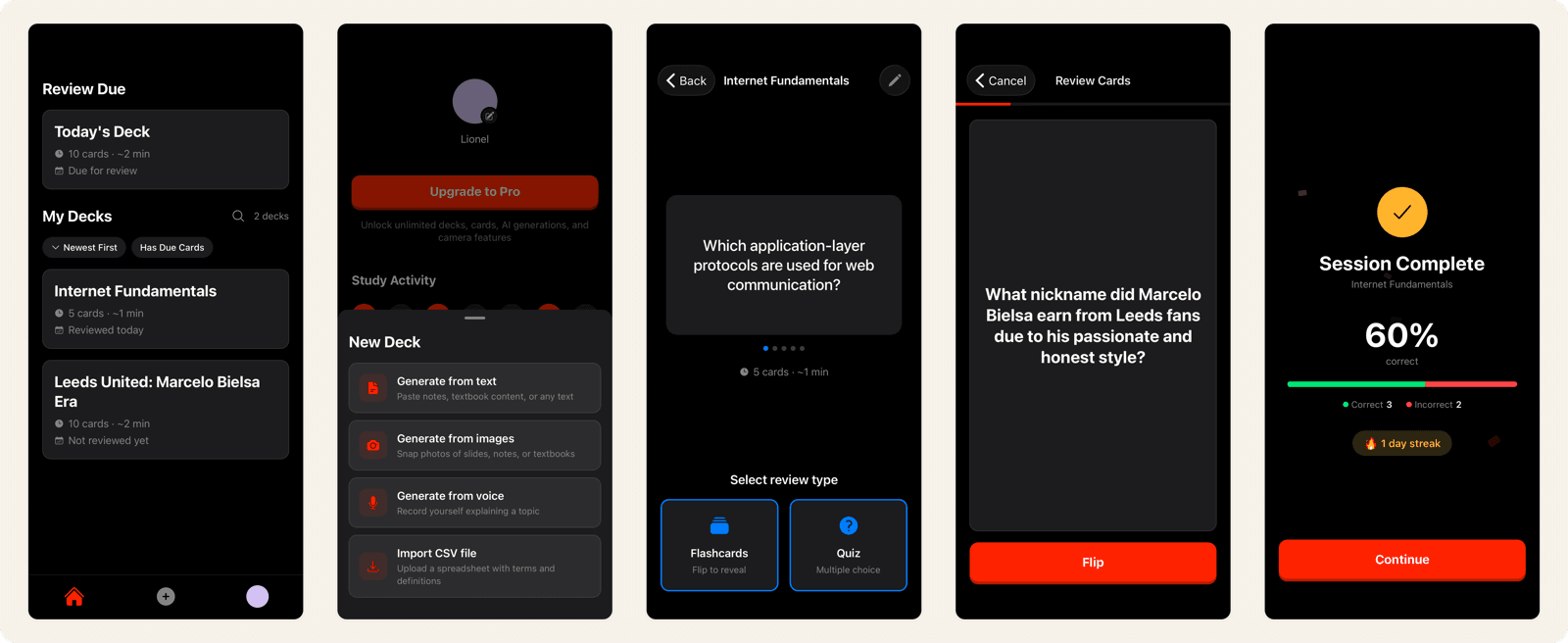
The core workflow is simple: photograph a vocabulary list, textbook page, or handwritten notes, and the AI creates flashcards matched to your actual study material. You can also paste text or use voice input. Where Memrise confines you to its curated courses, Sticky lets you study whatever you need to learn. The SM-2 spaced repetition algorithm then handles scheduling, using the same core system as Memrise but with intervals that adapt to your individual active recall performance on each card.
Memrise Features vs Sticky: Side-by-Side Comparison
Here is how Memrise and Sticky compare across the features that matter most for studying.
| Feature | Memrise | Sticky |
|---|---|---|
| Spaced repetition | SM-2 algorithm with set intervals | SM-2 algorithm, built into every review |
| Card creation | No custom cards in main app | AI from photos, text, and voice, plus CSV import |
| AI features | MemBot conversation, AI Buddies | Photo to Card, Note to Card (included) |
| Content model | Curated language courses only | Create from any material + curated decks |
| Languages | 35 official languages | Any language (via custom cards) |
| Native videos | Yes, core feature | No |
| Subjects | Languages only | Any subject |
| Platforms | iOS, Android, web | iOS |
| Ads | Yes (free tier) | No ads on any tier |
| Pricing | Free limited, Pro ~$5/mo annually | Free with premium options |
Memrise Spaced Repetition vs Sticky: Same Algorithm, Different Experiences
Both Memrise and Sticky use the SM-2 algorithm — the same spaced repetition system originally developed for SuperMemo. This is a significant similarity: the core scheduling science is identical.
Memrise's implementation uses fixed interval progressions: 4 hours, 12 hours, 24 hours, 6 days, 12 days, 48 days, 96 days, then 6 months. Getting a word wrong resets it to the first interval. The system predicts when a word is likely to fall out of long-term memory and schedules review accordingly. It is effective but rigid — the intervals are the same for every user regardless of individual performance.
Sticky's SM-2 implementation adjusts intervals based on your individual performance with each card. The algorithm tracks an ease factor for every card, so cards you consistently recall easily get pushed further apart while cards you struggle with stay in tighter rotation. This produces a more personalised review schedule over time.
The practical difference in daily use is small for beginners but grows over time. Both apps will show you weak items more often and strong items less often. Where they differ is in what surrounds the review: Memrise wraps spaced repetition in a language course with videos, exercises, and gamification. Sticky strips it down to the core review experience and focuses on making each session as efficient as possible.
Memrise Language Learning vs Sticky: Immersive Courses vs Flexible Cards
This is where the two apps serve fundamentally different needs.
Memrise is purpose-built for language learning. Its standout feature is "Learn With Locals" — short video clips of native speakers saying phrases in real-world settings. You hear real accents, see real body language, and get pronunciation exposure that a text-based flashcard simply cannot provide. The AI conversation features (MemBot and the newer AI Buddies) let you practise speaking and get pronunciation feedback. Memrise also uses gamification — streaks, points, leaderboards — to keep learners engaged.
The limitation is that Memrise only works for languages, and only with its official curated content. You cannot create your own vocabulary lists in the main app, study from your own textbook, or use it for any subject besides language learning. If your vocabulary needs do not align with Memrise's courses, you are stuck.
Sticky is subject-agnostic. You can create flashcards for Spanish vocabulary, anatomy terms, AP Biology, or anything else. For language learners specifically, you can photograph a vocabulary list from your textbook or class handout and have AI generate flashcards matched to what you are actually studying in school — not a generic course progression.
The trade-off is real. If you are a beginner learning a new language from scratch and want an immersive, guided experience with video and conversation practice, Memrise is specifically designed for that. If you are a student studying vocabulary for a language class, preparing for an exam, or learning any non-language subject, Sticky's flexibility and AI card creation serve a much broader range of needs.
Memrise Pricing vs Sticky: What You Actually Pay
Memrise's free tier gives access to basic courses with ads and limited features. Many learners find they need Pro relatively quickly to access all vocabulary lessons, native speaker videos, and the ad-free experience.
Memrise Pro pricing:
- Monthly: ~$12.99/month
- Annual:
$5/month ($60/year) - Lifetime: ~$179.99
Sticky is free to download with core features included — AI card creation and SM-2 spaced repetition scheduling. There are no ads on any tier.
For dedicated language learners, Memrise Pro's annual plan at ~$60/year is reasonable given the quality of the native speaker content and AI conversation features. For students who need a general-purpose flashcard app with spaced repetition, Sticky's free tier covers the core workflow without a subscription.
Who Should Use Memrise
Memrise is a strong choice if:
- You are learning a new language from scratch. Memrise's structured courses, native speaker videos, and progressive difficulty are specifically designed for beginners building foundational vocabulary.
- You value immersive video content. The "Learn With Locals" feature provides pronunciation and cultural context that text-based flashcards cannot match.
- You want AI conversation practice. MemBot and AI Buddies give you a way to practise speaking and get feedback without a human tutor.
- You respond to gamification. Streaks, points, and leaderboards help some learners maintain consistency.
- You want a guided curriculum. If you prefer following a structured course over building your own study material, Memrise provides a clear path through each language.
Who Should Use Sticky
Sticky is a strong choice if:
- You study more than just languages. Sticky works for any subject — science, history, medicine, test prep, professional certifications. If you need spaced repetition for exam preparation, language is just one option.
- You want to study your own material. If your language class uses a specific textbook or vocabulary list, Sticky lets you create flashcards from that material instantly with AI — no need to find a matching course.
- You want proven spaced repetition without extras. Sticky focuses on the science that actually drives retention: active recall with optimally spaced intervals. No gamification, no leaderboards — just effective studying.
- You want an ad-free experience. Sticky has no ads on any tier, which means uninterrupted focus during review sessions.
- You prefer a mobile-first workflow. Sticky's camera-to-card workflow is built for students who capture material on the go. It also offers curated decks for popular subjects like Spanish vocabulary and French vocabulary if you want a head start.
Is Sticky the Best Memrise Alternative?
Memrise and Sticky serve different primary use cases. Memrise is a language learning platform with spaced repetition built in — it excels at immersive vocabulary acquisition for beginners through native speaker content and AI conversation practice. Sticky is a general-purpose flashcard app with AI card creation and spaced repetition scheduling — it excels when you want to study any material on a proven review schedule.
If language learning is your only goal and you want a guided, immersive experience, Memrise is purpose-built for that. If you want spaced repetition that works for any subject — including languages — and the freedom to create cards from your own study material, Sticky is the more flexible option.
Both apps use the same SM-2 algorithm at their core. The difference is everything around it. For language learners who also study other subjects, or for anyone who wants one study app that handles everything, Sticky's combination of AI card creation and universal spaced repetition covers more ground.
Looking at other flashcard apps too? See how Sticky compares to Quizlet, Anki, and RemNote, or explore more study guides and learning science to find the method that works best for you.