Brainscape has been in the flashcard space since 2010, built around a proprietary algorithm called Confidence-Based Repetition. It has carved out a strong niche in test prep and professional certification, with a marketplace of publisher-certified decks covering everything from the MCAT to the bar exam.
Sticky takes a different approach. Instead of a marketplace of pre-made content, it focuses on turning your own study material into flashcards instantly using AI, then scheduling your reviews with the SM-2 spaced repetition algorithm.
Both apps use adaptive scheduling to help you retain more in less time. But they are designed around different philosophies: Brainscape gives you a library of expert-made content and a confidence-based rating system, while Sticky gives you AI card creation from your own notes and a clean, mobile-first review experience. Here is how they stack up across the features that matter most.
Quick Verdict
you want access to a large marketplace of certified, pre-made flashcard decks — especially for standardised test prep and professional certifications — and prefer a confidence-based rating system.
you want AI to create flashcards from your own notes instantly and prefer true SM-2 spaced repetition in a clean, mobile-first app without paying for a subscription to unlock core features.
What Is Brainscape?
Brainscape is a flashcard platform founded in 2010 by Andrew Cohen, who developed the concept while studying education technology at Columbia University. The app is built around Confidence-Based Repetition (CBR), a proprietary algorithm where you rate your confidence on each card from 1 to 5, and the system adjusts how frequently you see each card based on those ratings.
Brainscape's other major draw is its content marketplace. It partners with publishers and educators to offer certified flashcard decks for standardised tests, medical exams, law school, and professional certifications. The marketplace model means you can find high-quality, pre-made content without creating a single card yourself — though full access requires a Pro subscription. Brainscape is available on iOS, Android, and the web, with around 42 employees across five continents.
What Is Sticky?
Sticky is an iOS flashcard app that pairs AI card creation with the SM-2 spaced repetition algorithm — the same scheduling system validated by decades of cognitive science research.
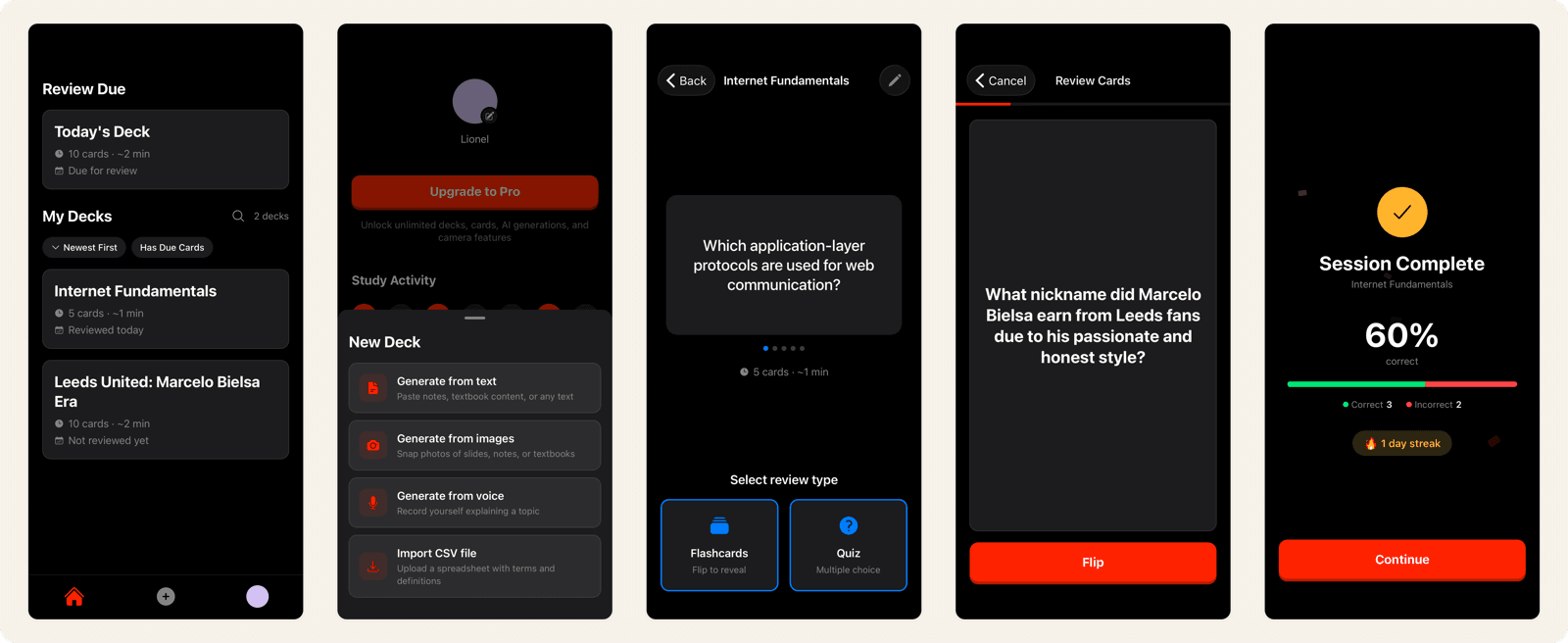
Where Brainscape gates AI generation and images behind a Pro subscription, Sticky includes AI card creation at no cost. You photograph your notes, textbook, or whiteboard and the AI produces a full deck of flashcards in seconds. You can also paste text or use voice input. There is no marketplace to subscribe to — the focus is on turning your specific study material into cards fast and scheduling your reviews with active recall built in.
Brainscape Features vs Sticky: Side-by-Side Comparison
Here is how Brainscape and Sticky compare across the features that matter most for studying.
| Feature | Brainscape | Sticky |
|---|---|---|
| Spaced repetition | Confidence-Based Repetition (1-5 scale) | SM-2 algorithm, built into every review |
| Card creation | Manual typing, AI Copilot (Pro only) | AI from photos, text, and voice, plus CSV import |
| AI features | Flashcard Copilot (Pro subscription) | Photo to Card, Note to Card (included) |
| Card types | Front/back text only | Front/back, AI-generated Q&A pairs |
| Pre-made content | Large certified marketplace (Pro) | Curated subject decks |
| Platforms | iOS, Android, web | iOS |
| Offline access | Mobile with download | No |
| Images on cards | Pro only | Yes |
| Math & equations | None (screenshot workaround only) | Full LaTeX rendering |
| Pricing | Free basic, Pro from $7.99/mo | Free with premium options |
Brainscape Spaced Repetition vs Sticky: Different Algorithms, Same Goal
Brainscape and Sticky both use adaptive scheduling, but the underlying systems work differently.
Brainscape uses Confidence-Based Repetition (CBR). After seeing the answer to a card, you rate your confidence from 1 (no idea) to 5 (perfectly knew it). Cards rated 1 or 2 come back frequently; cards rated 4 or 5 are pushed further into the future. The algorithm also factors in how many decks you are studying, your previous patterns, and the time since your last review. It is a real-time adaptive system rather than a traditional interval-based scheduler.
Sticky uses the SM-2 algorithm — the same system originally developed for SuperMemo and used by Anki. When you review a card and rate it Easy, Medium, or Hard, the algorithm calculates a specific next review date based on your history with that card. Each successful recall increases the interval; each failure shortens it. SM-2 is one of the most studied and validated spaced repetition algorithms in learning science.
The practical difference: CBR adjusts frequency based on a confidence snapshot, while SM-2 builds a mathematical model of your memory for each individual card. Both approaches help you focus on weaker material, but SM-2's interval-based scheduling is more directly tied to the forgetting curve research that underlies spaced repetition.
Brainscape Card Creation vs Sticky: Marketplace vs AI from Your Notes
This is where the two apps differ most in daily use.
Brainscape's primary card creation method has historically been manual — you type front and back text for each card. More recently, Brainscape Pro added a Flashcard Copilot powered by ChatGPT that can generate cards from a topic description or convert pasted notes into flashcards. However, this AI feature is locked behind the Pro subscription.
The other path is Brainscape's marketplace. For standardised tests and professional certifications, you can browse and study pre-made decks created by publishers and subject matter experts. This is genuinely valuable if your study material aligns with available decks — you get expertly crafted cards without any creation effort. The catch is that full marketplace access also requires Pro.
Sticky's approach starts with AI and does not require a subscription. The primary workflow is taking a photo of your study material and letting the AI extract key concepts and generate question-answer pairs. A page of lecture notes becomes a study deck in seconds. You can also paste text directly or use voice input.
The trade-off is genuine. Brainscape's marketplace offers polished, expert-vetted content for specific exams and certifications. Sticky's AI creates cards from whatever material you are actually studying, which is more flexible but without the expert curation. If you are studying for the MCAT and want a pre-built deck, Brainscape's marketplace is hard to beat. If you are studying from your own lecture notes and want cards fast, Sticky's AI workflow is significantly faster.
Brainscape Math & Equations vs Sticky: A Missing Feature
If you study any STEM subject — physics, chemistry, calculus, engineering, statistics — equation support on flashcards is not a nice-to-have. It is essential for effective study.
Brainscape does not support LaTeX, MathJax, or any form of native equation rendering. The only option for including equations on your cards is to screenshot them from another application (like a textbook PDF or equation editor) and upload the image. Brainscape's own help centre confirms this is the recommended approach.
This workaround has real costs. Screenshot-based equations cannot be searched, cannot be edited after creation, and often look blurry or improperly sized across different devices. If you make an error in an equation, you have to go back to the external tool, fix it, take a new screenshot, and re-upload it. For a student creating hundreds of cards with formulas, this friction adds up quickly.
The equation feature has been one of Brainscape's most-requested features since 2013 — over a decade of user requests. Community members have suggested implementing KaTeX or MathJax for client-side rendering. Brainscape has acknowledged the request as being "in the works" but has not shipped it.
Sticky supports full LaTeX rendering on flashcards. You type LaTeX syntax — fractions, integrals, Greek letters, chemical formulas, matrices — and see properly formatted equations that render natively on your cards. No screenshots, no external tools, no workarounds. Your equations are searchable, editable, and display consistently on any screen size.
For students in humanities or language learning, this gap will not affect your choice. But if your flashcards need equations, this is a straightforward differentiator. Learn more in our guide to creating math flashcards with LaTeX.
Brainscape Pricing vs Sticky: What You Actually Pay
Brainscape's free tier lets you create and study your own flashcards with the CBR algorithm. But several features that many students consider essential are Pro-only: images on cards, audio, full marketplace access, and unlimited AI card generation.
Brainscape Pro pricing:
- Monthly: $19.99/month
- Semester: $9.99/month
- Annual: $7.99/month (~$96/year)
- Lifetime: $199.99
Sticky is free to download with core features included, including AI card creation and SM-2 spaced repetition scheduling. There are no ads on any tier.
The pricing difference is meaningful. At $19.99/month, Brainscape's monthly plan is among the most expensive flashcard apps available. Even the annual plan at ~$96/year is a significant commitment. For students already stretched thin, paying a subscription to add images to flashcards or access AI features can feel like a barrier to studying effectively.
Who Should Use Brainscape
Brainscape is a strong choice if:
- You want expert-made flashcard decks. If you are preparing for a standardised test, professional certification, or medical exam, Brainscape's marketplace offers publisher-certified content that can save significant preparation time.
- You prefer confidence-based rating. The 1-5 scale gives you more granularity than a simple Easy/Medium/Hard rating, which some learners find more intuitive.
- You study on multiple platforms. Brainscape works on iOS, Android, and web, which is useful if you switch between devices regularly.
- You value curated content over custom content. If you would rather study from a vetted deck than create your own cards, Brainscape's marketplace model is well-suited to that workflow.
Who Should Use Sticky
Sticky is a strong choice if:
- You want to study your own material without hours of card creation. If you have lecture notes, textbook pages, or handwritten notes, Sticky turns them into flashcards in seconds with AI — no subscription required.
- You want proven SM-2 spaced repetition. Sticky uses the same algorithm that has been validated by decades of cognitive science research, with zero configuration required.
- You do not want to pay for core features. Sticky includes AI card creation, spaced repetition scheduling, and images on cards without a Pro subscription.
- You want a clean, mobile-first experience. No marketplace to browse, no settings to tune — just your cards and a review schedule. Sticky also offers curated decks for popular subjects like AP Biology and SAT Math if you want a head start.
- You are new to spaced repetition. If you want effective flashcard study without a learning curve, Sticky is designed to get you studying in under a minute.
Is Sticky the Best Brainscape Alternative?
Brainscape and Sticky are both solid flashcard apps, but they serve different needs. Brainscape is built around a content marketplace and a confidence-based rating system — it is strongest when you want pre-made, expert-vetted decks for specific exams. Sticky is built around AI card creation and SM-2 scheduling — it is strongest when you want to turn your own notes into flashcards and start reviewing immediately.
If you are willing to pay for a Pro subscription and your study material aligns with Brainscape's marketplace offerings, it delivers real value. If you want AI-powered card creation and proven spaced repetition science without a paywall, Sticky is the more accessible option.
The best flashcard app is the one you actually use consistently. For many students, that means removing friction — and Sticky's combination of instant AI card creation and automatic review scheduling makes it easy to study every day without spending time on setup.
Considering other options? See how Sticky compares to Quizlet, Anki, and Knowt, or explore more study guides and learning science to find the method that works best for you.